Oil Prices and Geopolitics: Building Energy Shocks Into Corporate Planning
For most non-energy firms, the largest oil exposures are feedstock costs and customer demand — the two channels least often modelled.
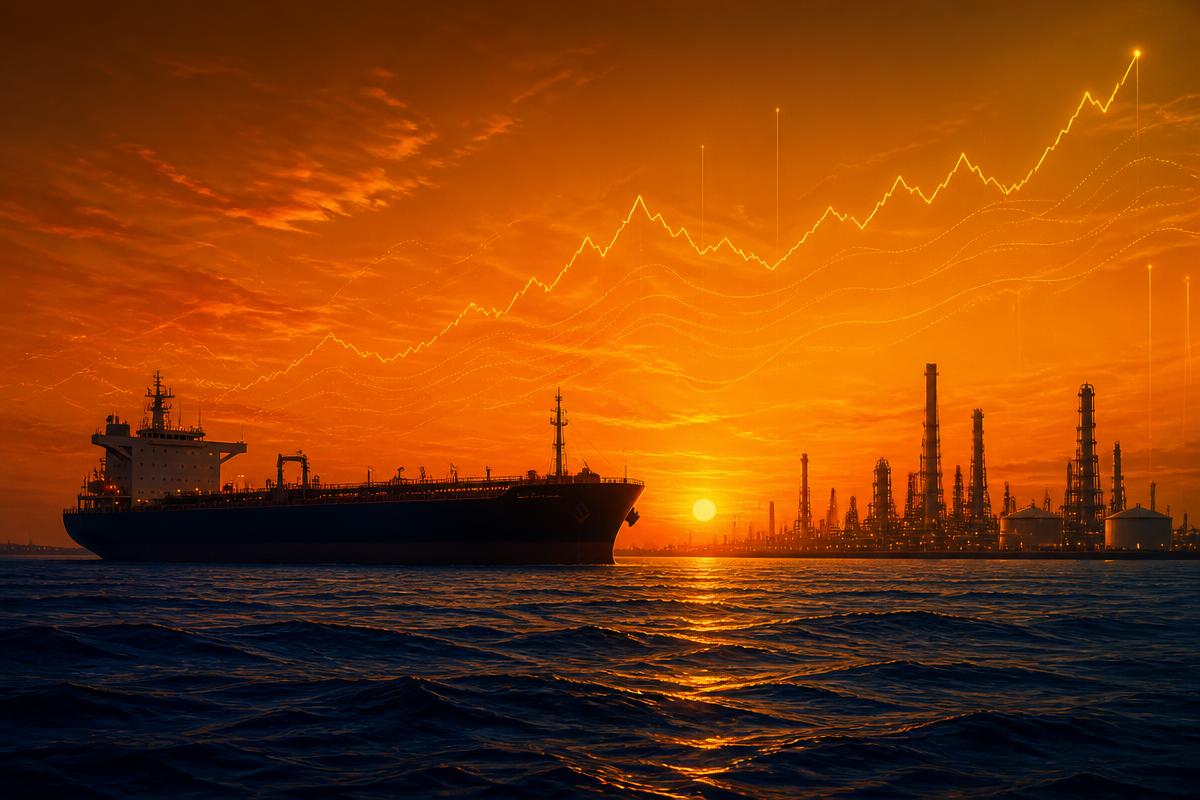
Oil prices are a geopolitical instrument, not just a commodity
Oil price volatility reaches corporate planning through four channels: direct energy cost, freight and logistics cost, input costs in petrochemical-derived materials, and demand destruction in customer markets. For most non-energy enterprises the third and fourth channels are larger than the first — and they are the two least often modelled.
The price of crude is set at the margin by a small number of decisions: how much spare capacity producers choose to hold back, whether a chokepoint stays navigable, whether sanctioned barrels find buyers, and how quickly refined-product inventories can be rebuilt. Each of those is a political variable before it is an economic one. That is what makes energy the clearest worked example of geopolitical analysis in international business.
The transmission map most planning cycles are missing
Build the transmission map before building a hedging strategy. A workable version has five layers.
1. Direct consumption. Fuel, electricity and process heat by site, with contract structures and reset dates noted. Straightforward, and usually already known.
2. Freight exposure. Bunker fuel and jet fuel pass into ocean and air freight with a lag of weeks. Insurance premia on high-risk routings move faster than fuel does, and in a chokepoint event they can move further.
3. Feedstock and materials. Polymers, resins, solvents, fertilisers, synthetic fibres and bitumen inherit crude and gas prices with lags of one to two quarters. Firms that believe they have no oil exposure frequently have it here, embedded in a tier-two supplier's price index.
4. Customer demand. In energy-importing economies a sustained price rise is a consumption tax; discretionary demand weakens, industrial output slows, and currencies of import-dependent countries come under pressure. In exporting economies the effect reverses, which is why a portfolio view matters more than a single price forecast.
5. Sovereign and counterparty stability. For producer states, prolonged low prices strain budgets, delay state contracts and slow payment cycles. Enterprises with public-sector receivables in those markets carry a working-capital exposure that never appears in an energy line item.
Chokepoints, sanctions and the shape of a shock
Two structural features determine how an oil shock behaves.
The first is geography. A large share of seaborne crude and refined product transits a handful of maritime passages. Disruption at any of them does not remove barrels from the world, it lengthens the voyage — which raises freight, ties up tanker capacity, and widens regional price spreads. The corporate consequence is often a logistics problem masquerading as a commodity problem.
The second is the sanctions architecture. Restricted barrels do not vanish; they re-route, change flag, and trade at discounts through longer intermediary chains. For an enterprise, the risk migrates from price to compliance: cargo provenance, shipping intermediaries, insurance and payment routing all become due-diligence surfaces. A procurement team optimising landed cost can walk into a restricted-party problem without ever intending to.
Scenario design that produces decisions
Point forecasts of crude are close to worthless for planning; the error bars exceed the planning sensitivity. Ranges with mechanisms are useful. A defensible set for an annual cycle:
- Base range — supply and demand broadly balanced, spare capacity intact, no sustained chokepoint disruption. Plan the operating budget here.
- Supply-shock range — a producer outage or a corridor disruption persisting beyond a quarter. Model freight and insurance as well as crude; that is where the surprise usually sits.
- Demand-weakness range — synchronised slowdown or accelerated efficiency and electrification. Test producer-market receivables, project pipelines and any revenue tied to state capital spending.
- Fragmentation range — sanctions and re-routing widen regional spreads persistently, so a single global price stops describing your cost base. Test whether contracts, indices and transfer pricing still function.
For each range, name three things: the financial consequence, the indicator that would tell you it is happening, and the action already agreed with an owner and a lead time. A scenario without those three is an essay.
Hedging is a treasury tool, not a strategy
Financial hedging buys time; it does not change exposure. It works best when the exposure is well measured, the horizon is short, and the instrument matches the physical risk — and it fails predictably when a firm hedges crude while its actual exposure is to diesel cracks, freight rates or a producer-market currency.
The structural levers matter more over a three-year horizon: contract indexation and pass-through clauses, dual-sourcing of feedstock across price basins, energy efficiency and electrification where it changes the exposure rather than the reporting, network design that shortens or diversifies routings, and pricing agility so that cost movement can be passed to customers within a defined window.
Governance: who owns the energy view
In most large enterprises energy price risk is split — treasury hedges, procurement contracts, operations consumes, and strategy assumes. No one owns the aggregate. The fix is unglamorous: a single quarterly energy exposure view that consolidates all four, presented alongside the geopolitical indicator set rather than separately from it, with pre-agreed trigger points and named owners.
Boards should be able to answer three questions on demand: what a sustained price move of a defined size does to operating margin; where in the network a corridor disruption first bites and how long the buffer lasts; and which counterparties become fragile at the other end of the range.
The through-line
Oil prices are the most visible edge of a wider condition — an operating environment where policy, security and economics move together. Treating energy as a standalone commodity question tends to produce a hedging conversation. Treating it as a geopolitical exposure question produces a network, contracting and capital conversation, which is where the durable value sits.
Related reading: our guides to geopolitical supply chain exposure mapping and quantifying geopolitical risk. For advisory support, see strategic consulting or book an executive consultation.